

4 Lower Back Pain Myths Debunked!
70-90% of people will have an episode of lower back pain in their lives. With all this attention that lower back pain gets, there’s some great information out there on how to manage it super effectively. HOWEVER, unfortunately, there’s still plenty of well past their use-by date, age-old myths about back pain in circulation, and that we still hear regularly.
So I have decided to investigate 4 lower back pain MYTHS, and discuss why they are indeed not true!
Myth 1: ‘My back pain is due to something being out of place’
Our spinal disc, or internal shock absorbers, are firmly attached to the vertebrae they sit between. These are extremely strong, making it virtually impossible for them to ‘slip’. What people are likely referring to is a disc bulge or herniation, where the jelly-like material within the disc becomes displaced, very different from a disc slipping out. So there you go, Discs don’t slip. Never have. Never will. Research has also shown that discs have an amazing capacity to heal when they are injured, with 2 in 3 completely resolving or shrinking within a period of months.
You’re spine also doesn’t go out. There can be very minute changes in spinal alignment in very small groups of people, however, this has a very poor correlation to pain and so is unlikely to be the main driver of your back pain.
Myth 2: ‘Bending forward is bad for my back’
Your back is a resilient structure. By its very nature, it is designed to be flexible to allow us to move. Bending forward is a normal function of the spine and doesn’t need to be feared or completely avoided. Where some run into trouble is when they perform repeated activities, which cumulatively becomes over and above what their spines can cope with. One example is shifting boxes when moving house. This exposes your spine to repeated loads over and above the norm. This more to do with the cumulative build-up of stress over time that your spine is not accustomed to, rather than the act of bending forward.
Myth 3: ‘Bed rest is the best for my back when it’s sore’
In the first few days after the initial injury, avoiding aggravating activities may help to relieve pain. However, there is very strong evidence that keeping active and returning to all usual activities is important in aiding recovery.
In contrast, prolonged bed rest is unhelpful. This has been associated with higher levels of pain, greater disability, poorer recovery and greater absence from work. In fact, it appears that the longer you stay in bed because of back pain, the worse your pain becomes. Therefore, while performing some common tasks at work and home may initially be painful, early and gradual return to all these tasks is better for your back than prolonged rest.
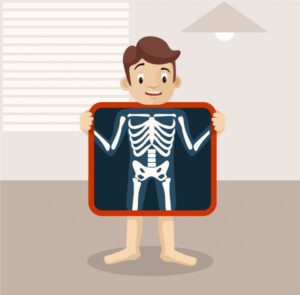 Myth 4: ‘I’ve got back pain, I need a scan to find out what’s wrong’
Scans are only needed when there is suspicion of something more sinister at play. Research has found that back pain symptoms and findings on scans like disc bulges and arthritis are poorly correlated. Findings like disc bulges and arthritis are also found on scans in completely pain free people as well! We can treat back pain very effectively through a thorough assessment and can tell you whether or not there’s a need for a scan.
So there you go! We hope this has clarified and debunked some of the most common myths surrounding lower back pain.
The key take-home here is that your spine ISN’T made of glass! It is a strong and resilient structure that is designed to move. If you.
Osteopathic treatment focuses on finding and addressing these problematic symptoms and providing strategies to overcome them. This allows the body to heal itself rather than masking the symptoms with medication or just treating the symptoms.
Book your appointment with us today and get help from our passionate Osteopaths, who are committed to helping you find lasting pain relief!
Equilibrium Sports and Spine Clinic is your local provider of osteopathy services. We offer a wide range of Osteopathy treatments to the communities surrounding Glen Iris, Malvern, Hawthorn, Caulfield, Ashburton, Camberwell Kooyong South Yarra Toorak. Take care of your upper back pain by booking an appointment today!